The Head-dresses: MAUR and MAURI

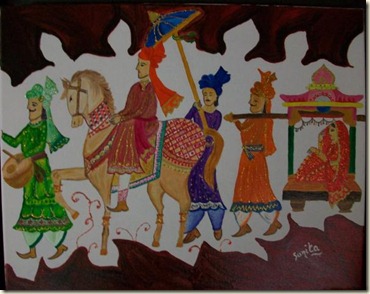
There are two head- dresses, one worn by the bridegroom, which was earlier made of talipot-leaves but now a days made of some ornamental paper,mirror etc. is called maur ; the other is worn by the bride, and is mauri, or patmauri. The bride's head-dress is made of date-leaves or mango leaves. These are brought to the bride's house and the maur is put on the mother's head and the mauri on the bride's head.
The bridegroom's party then returns to the janwasa, and the bride goes inside the house and exchanges her kaneyai or bihauti for her wedding dress piyeri. The father or elder male relat
ion brings the bride and seats her beside the bridegroom under the marhwa to his left. Some one belonging to the bride's family then goes inside and gets the bridegroom's maur from the bride's mother, and brings it out, and it is put on the bridegroom's head.
The marriage service is now read by the Purohit. This is called shumangali. The bridegroom sits under the marhwa in front of the bride. The father of the bride sits kneeling on one knee, keeping the bride sitting on his other thigh. This is the ceremony of giving the girl in marriage, and is called kanyadan.
The officiating Purohit recites verses from the Vedas, and leads in various acts of worship. From the time of the arrival of the bariyat up to the completion of the kanyadan the father and mother of the bride can eat nothing.
Next follows the knotting together of the clothes of the bride and bridegroom. This is gath bandhan or genth jor same time something of small value, such as few paisa or sometimes a piece of betel-nut, is tied in the bride's waist-band and in her breast-cloth by the Purohit. Sometimes an ornament is tied to the bride's sheet, which is called anchri .
The moving round of the sacrificial fire is done by both bride and bridegroom. The bride holds it in her hands in front of her and the bridegroom follows her with an arm passing round her on each
side, also supporting the sieve. Her brother fills the sieve as they go along with parched grain prepared in the fireplace formerly under the marhwa, which the bridegroom at the same time scatters
by shaking the sieve with his hands .This is called lawa chhitai or lawa merai . Care is taken to keep the sacrificial fire to the right. It is considered unlucky for the girl to pass it to her left. This ceremony is called bhawar or fera. This is performed seven times, and is the important part of the ceremony. This is followed by the application of vermilion. In this the bridegroom takes a small wooden cup , sinhoura containing vermilion in one hand, and applies vermilion to the parting of the bride's hair with a piece of hemp. This is called senur dan or sindur dan.
The couple then leave the courtyard and go into the house where the family deity is put. This house
is called kohbar. At the door they are stopped by the sister of the bride, who requires
the bridegroom to repeat certain verses, called duraundh or duar path. The bridegroom demands a present for doing so, and on this being given he repeats the verses. This ceremony is called duar chhenkai .
The bridegroom takes off his shoes before entering the house. If he is silent or is too nervous to speak much, the bride's sister may, as a joke, steal his shoes while he is inside, and conceal them somewhere, in order to compel him on his reappearance to speak, " where are my shoes ? " This ceremony is called juta chorai .
The couple then kneel facing the north-east, and perform the worship of the tutelary deity of the family, offerings being made to him at the same time. This is called gor lagai. The clothes of the bride and bridegroom are then untied, the promised presents given to the sister of the bridegroom, and the marriage is concluded.

There are two head- dresses, one worn by the bridegroom, which was earlier made of talipot-leaves but now a days made of some ornamental paper,mirror etc. is called maur ; the other is worn by the bride, and is mauri, or patmauri. The bride's head-dress is made of date-leaves or mango leaves. These are brought to the bride's house and the maur is put on the mother's head and the mauri on the bride's head.
The bridegroom's party then returns to the janwasa, and the bride goes inside the house and exchanges her kaneyai or bihauti for her wedding dress piyeri. The father or elder male relat

ion brings the bride and seats her beside the bridegroom under the marhwa to his left. Some one belonging to the bride's family then goes inside and gets the bridegroom's maur from the bride's mother, and brings it out, and it is put on the bridegroom's head.
The marriage service is now read by the Purohit. This is called shumangali. The bridegroom sits under the marhwa in front of the bride. The father of the bride sits kneeling on one knee, keeping the bride sitting on his other thigh. This is the ceremony of giving the girl in marriage, and is called kanyadan.
The officiating Purohit recites verses from the Vedas, and leads in various acts of worship. From the time of the arrival of the bariyat up to the completion of the kanyadan the father and mother of the bride can eat nothing.
Next follows the knotting together of the clothes of the bride and bridegroom. This is gath bandhan or genth jor same time something of small value, such as few paisa or sometimes a piece of betel-nut, is tied in the bride's waist-band and in her breast-cloth by the Purohit. Sometimes an ornament is tied to the bride's sheet, which is called anchri .
The moving round of the sacrificial fire is done by both bride and bridegroom. The bride holds it in her hands in front of her and the bridegroom follows her with an arm passing round her on each
side, also supporting the sieve. Her brother fills the sieve as they go along with parched grain prepared in the fireplace formerly under the marhwa, which the bridegroom at the same time scatters
by shaking the sieve with his hands .This is called lawa chhitai or lawa merai . Care is taken to keep the sacrificial fire to the right. It is considered unlucky for the girl to pass it to her left. This ceremony is called bhawar or fera. This is performed seven times, and is the important part of the ceremony. This is followed by the application of vermilion. In this the bridegroom takes a small wooden cup , sinhoura containing vermilion in one hand, and applies vermilion to the parting of the bride's hair with a piece of hemp. This is called senur dan or sindur dan.
The couple then leave the courtyard and go into the house where the family deity is put. This house
is called kohbar. At the door they are stopped by the sister of the bride, who requires
the bridegroom to repeat certain verses, called duraundh or duar path. The bridegroom demands a present for doing so, and on this being given he repeats the verses. This ceremony is called duar chhenkai .
The bridegroom takes off his shoes before entering the house. If he is silent or is too nervous to speak much, the bride's sister may, as a joke, steal his shoes while he is inside, and conceal them somewhere, in order to compel him on his reappearance to speak, " where are my shoes ? " This ceremony is called juta chorai .
The couple then kneel facing the north-east, and perform the worship of the tutelary deity of the family, offerings being made to him at the same time. This is called gor lagai. The clothes of the bride and bridegroom are then untied, the promised presents given to the sister of the bridegroom, and the marriage is concluded.


